
For decades, homeowners viewed their property as simply a place to live.
Today, new housing laws have created opportunities for homeowners to add housing, create income, support family members, build wealth, and improve retirement security without leaving the property they love.
At Sockeye Homes, we specialize in designing and building custom Accessory Dwelling Units (ADUs) and Detached Accessory Dwelling Units (DADUs) throughout the Puget Sound region.
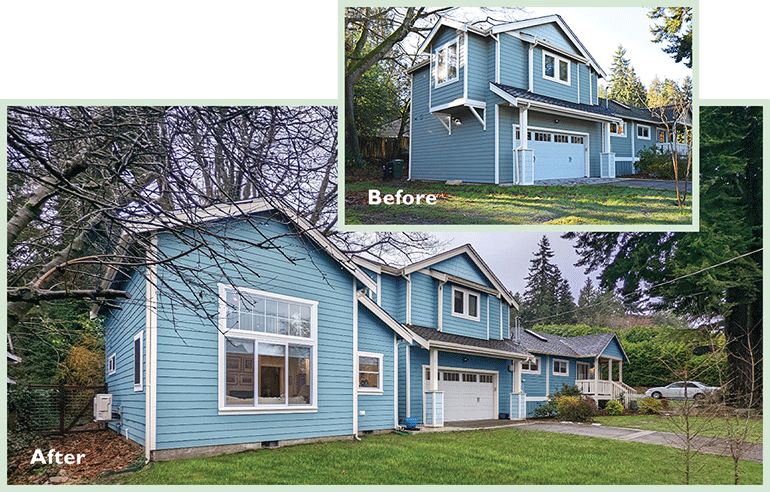
An Attached Accessory Dwelling Unit (AADU) is integrated into the existing home through an addition, conversion, or expansion. These homes typically include their own entrance, kitchen, bathroom, and living space while remaining connected to the primary residence.
If you are considering an addition or an attached ADU, visit our Additions page to learn more.
A Detached Accessory Dwelling Unit is much more than a backyard cottage.
For many homeowners, a DADU can become:
Because of these opportunities, Sockeye Homes created a dedicated sister company, SkyDADU.

SkyDADU was created to help homeowners understand not only how to build a DADU, but why.
Through SkyDADU, homeowners can learn about:
While Sockeye Homes builds the home, SkyDADU helps create the strategy.
ADU stands for Accessory Dwelling Unit. It is an umbrella term for several possible options for housing more people on a single residential property. The options include AADU, JADU, and DADU all of which are described in more detail below.
Also known as an AADU, an Attached ADU is defined most simply as an Attached Accessory Dwelling Unit. To be designated as such there must be at least one wall or ceiling that is contiguous with the primary residence on the property.
An AADU is an attached dwelling unit created by expanding or reconfiguring your existing home. It can be a new addition with its own exterior entrance, or it can be formed by converting interior space—such as a basement, attic, or a separated portion of the main house—into a fully independent living area with its own kitchen, bathroom, and dedicated entry.
A Junior Accessory Dwelling Unit (JADU) — a term most commonly used in California — is a small, attached accessory unit created entirely from existing conditioned space within the main home. A JADU is typically no larger than 500 sqft, has its own separate entrance, includes an efficiently designed kitchen, and receives its utilities through the primary residence’s accounts.
Washington State has no such separate designation for a small, attached dwelling unit. To learn more about ADU-related laws in Washington State visit: https://skydadu.com/hb-1337-explained.
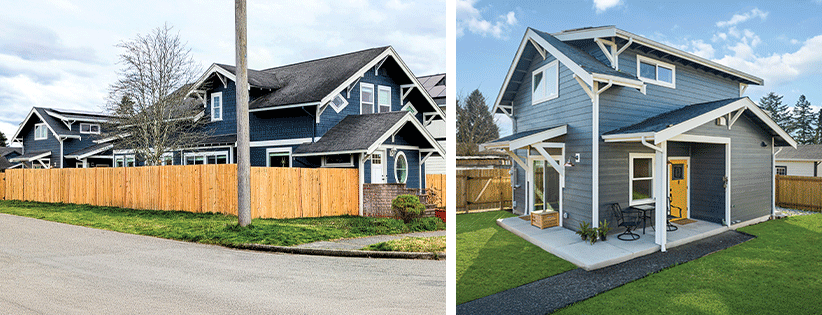
DADU stands for Detached Accessory Dwelling Unit. This structure does not share any walls with an existing home. It can be one-story, two- or three-story and may or may not have a garage.
When most people say “ADU,” they’re usually referring to an AADU (Attached Accessory Dwelling Unit)—a secondary living space that is physically connected to or integrated within the existing home. A DADU (Detached Accessory Dwelling Unit), on the other hand, is a stand alone structure completely separated from the primary residence and may operate on independent utility connections.
Recent statewide legislation in Washington has transformed DADUs into one of the most attractive infill housing options available to homeowners. These reforms apply across all counties, including King, Pierce, and Snohomish, and significantly expand where and how DADUs can be built. By easing zoning restrictions, standardizing approval pathways, and allowing multiple ADUs per lot, the new laws make it far simpler for property owners to add a fully detached, code compliant home on their existing residential parcel. For many homeowners, this shift unlocks new opportunities for multigenerational living, rental income, aging in place solutions, and build and sell strategies—all while contributing to Washington’s broader goal of increasing gentle density housing in established neighborhoods.
Plans for Detached Accessory Dwelling Units that meet Washington State regulations can be found at SkyDADU DADU Packages.
You can also find information regarding how to plan, build, and finance a custom DADU at: https://skydadu.com/custom-design-build-dadus.
Before choosing a floor plan, selecting finishes, or evaluating construction costs, the most important question is: What are you trying to accomplish?
To learn more about DADU opportunities, financing programs, ownership strategies, and the educational resources featured in the SkyDADU Homeowner Guide, visit:
The DADU experts at Sockeye Homes will build it. SkyDADU will help you plan it.
(253) 737-4456
Using our easy contact form